By Sylvia Marek Phenology is a science focused on observing and recording biological events from year to year and their relationships to the change of seasons and climate. These are the “normal” phenology events we expect to see here and in the Madison area this month. We would love to hear about what you are seeing on the grounds of Holy Wisdom Monastery. Please comment on this post with what you are observing, where at Holy Wisdom and the date you observed the event. I have kept monthly phenology records for many years and the following are from my June …
May phenology
By Sylvia Marek Phenology is a science focused on observing and recording biological events from year to year and their relationships to the change of seasons and climate. These are the “normal” phenology events we expect to see here and in the Madison area this month. We would love to hear about what you are seeing on the grounds of Holy Wisdom Monastery. Please comment on this post with what you are observing, where at Holy Wisdom and the date you observed the event. May May is a month of peak migration for warblers, vireos, thrushes, flycatchers, sparrows and many …
April phenology
By Sylvia Marek Phenology is a science focused on observing and recording biological events from year to year and their relationships to the change of seasons and climate. These are the “normal” phenology events we expect to see here and in the Madison area this month. We would love to hear about what you are seeing on the grounds of Holy Wisdom Monastery. Please comment on this post with what you are observing, where at Holy Wisdom and the date you observed the event. No month ends or begins overnight. Events can be a few weeks early or late. “Gaze …
A Story About a Lake and a Prairie and an Array of Solar Panels
Submitted by Amy Alstad, director of land management & environmental education, presented at the inaugural Spring Solar Tilt on Apr. 17, 2024 I’m here to share a story about a lake and a prairie and an array of solar panels. At first glance, this may seem like an unlikely trio of characters to encounter together in a single story. I hope to weave these three dissimilar threads into a common story that sets the stage for us today. We’ll start with the lake. The glacial lake that we know today as Lost Lake gets its name from the oral tradition …
Experiences at Holy Wisdom Monastery
Our mission is to weave prayer, hospitality, justice and care for the earth into a shared way of life. Here are some of the ways we invite you to live our mission with us. Prayer Holy Wisdom Monastery offers opportunity for spiritual growth every day of the week. Offerings include engaging in communal prayer, spending time in nature, attending a program or joining one of our spiritual communities, Oblates of Holy Wisdom Monastery, Center for Clergy Renewal or Sunday Assembly. Hospitality Our Benedictine tradition of hospitality means that all people are welcomed here as Christ. We invite you to experience this …
Painted Turtle Love
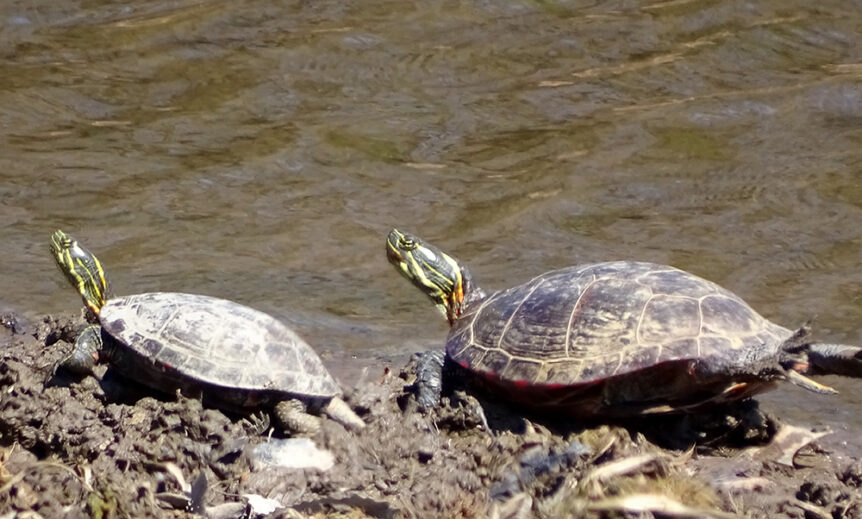
Submitted by Julie Melton, Friends of Wisdom Prairie and Sunday Assembly Member Remember painted turtles at Lost Lake basking on logs months ago? When they sense danger, they simply slide into the water and swim away. Some days you can see their noses poking out of the water. In winter they are living under the ice. With very slowed down respiration, they absorb dissolved oxygen through their skin. If the oxygen level drops too low, they absorb carbonate from their bones and skull which prevents them from dying by asphyxiation. Meanwhile, fall hatchling turtles and unhatched babies winter in nests …
How in the world do songbirds survive freezing cold?
By Julie Melton The short answer is that they find food and shelter. But there is more to it. Many songbirds grow a third more feathers in preparation for winter. Fluffing up feathers creates thousands of tiny air pockets that hold heat close to birds’ bodies. Outer feathers help hold the heat in. Birds have to keep their feathers oiled to maintain waterproofing. Insulation isn’t enough. Shelter is vital to survival. Birds can reduce their nighttime temperature to save energy. They still need protection from wind, snow and predators. Some birds huddle together in dense conifer boughs, shrubs, and under …
Julie Melton Receives 2022 Facilitator of the Year Award
Julie Melton, of Madison, has received the Facilitator of the Year Award from the Bluebird Restoration Association of Wisconsin (BRAW). Melton was recognized for her work at Holy Wisdom Monastery with prairie restoration as well as her environmental education programs. “I love leading people to a better understanding of how birds are connected to the prairie plants and the whole environment,” she added. President Steve Sample noted that “through her efforts Melton has helped to maintain and increase the Eastern Bluebird population, key goals of our statewide organization.” A fifth grade teacher who got Melton excited about birds is why …
Binoculars Available to Borrow While Exploring at Holy Wisdom Monastery
Friends of Wisdom Prairie is pleased to share a new opportunity: Holy Wisdom now has binoculars available for all to borrow. Bird watching is a lovely activity that perfectly complements Benedictine spirituality. It invites you to appreciate the beauty of creation. It pairs well with silence, stillness and contemplation, and connects you to the many birds flourishing here as a result of our work caring for the earth. To borrow a pair of binoculars, visit the front desk in the Monastery building and speak with the porter (front desk volunteer). Binoculars are available Monday-Friday starting at 10:00 am and must …
reSTORYation
“Words and names are the ways we human build relationships” -Robin Wall Kimmerer, Gathering Moss In this installment of reSTORYation, we invite you to deepen your connection to the land by exploring the place names given by others who have tended and honored this place. Phonetically spelled, Deyo-ha-waunee is the Ho-Chunk name for Lost Lake. Lake Mendota is called Wonk-sheck-ho-mikla. These names derive from Ho-Chunk oral traditions which can be further explored in the 1927 publication Lake Mendota Indian Legends. (attached) The map below animates some of the oral tradition behind the local Ho-Chunk place names, as relayed to Charles …