

By Sylvia Marek

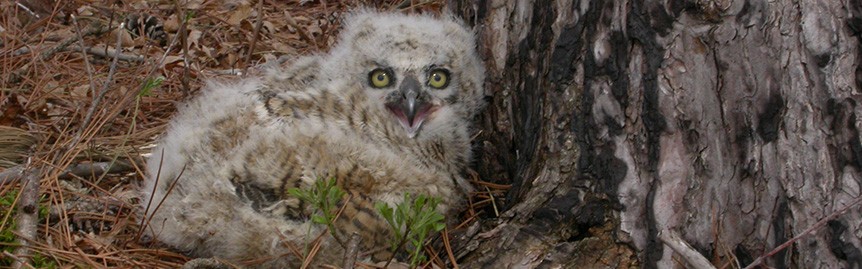
Baby great horned owl
Phenology is a science focused on observing and recording biological events from year to year and their relationships to the change of seasons and climate.
These are the “normal” phenology events we expect to see here and in the Madison area this month. We would love to hear about what you are seeing on the grounds of Holy Wisdom Monastery. Please comment on this post with what you are observing, where at Holy Wisdom and the date you observed the event.
No month ends or begins overnight. Events can be a few weeks early or late.
“Gaze at the beauty of the earth’s greening. All nature is at the disposal of humankind.
We are to work with it, for without it we cannot survive. The earth should not be
injured. The earth should not be destroyed.” –Hildegard Bingen
April phenology
April, a month to celebrate the wonder of new awakenings. It is a month of frosty mornings, occasional snow followed by warm temperatures, rain showers, sweet fragrances of new growth, bursting buds, blooming flowers, singing birds, sounds made by the wild ones, a landscape tinged with green and pastel colors, prairie and savanna prescribed burns, more than thirteen hours of daylight and much more.
Changing weather patterns can have an effect on when things happen. Events can occur a few weeks earlier or later than usual.
Resident birds
- Many of the following sing more frequently, find a mate, build a nest, lay eggs, and raise young: chickadee, cardinal, mourning dove, white-breasted nuthatch, house finch, tufted titmouse, the woodpeckers, house sparrow, crow, starling, turkey, and red-tailed hawk.
- Great horned and barred owls feed young owlets now.
- Screech owls incubate eggs in tree cavities.
Migrant birds
Short and long-distance migrants arrive almost daily on warm southern breezes.
- The following short distance migrants usually nest in mid-late April: bluebird, robin,
killdeer, phoebe, tree swallow, red-winged blackbird, Eastern towhee, brown thrasher,
house wren, sandhill crane, mallard, kingfisher, great blue heron, and song, field, and
chipping sparrows. - Others that usually arrive in late April but nest later include: blue-gray gnatcatcher,
catbird, kingbird, rose-breasted grosbeak, wood thrush, red-eyed vireo, warbling
vireo, hummingbird, bank and barn swallows, sedge and marsh wrens, and Lincoln’s,
clay-colored, savannah, swamp, and vesper sparrows. - Some migrants stay a short time, then travel to northern breeding grounds. Look
for white-throated, white-crowned, and fox sparrows, winter wren, yellow-bellied
sapsucker, flicker (some nest here), hermit, gray-checked, and Swainson”s thrush,
ruby-crowned kinglet, woodcock, bufflehead, shorebirds, and warblers such as
yellow-rumped, palm, pine, black and white, orange-crowned, ovenbird, and
Many small birds migrate at night. Listen for their “cheep, chirp, and seep”
calls as they fly overhead.
Winter visitors
- The following spent the winter here and will depart for northern breeding grounds:
dark-eyed junco, tree sparrow, brown creeper, pine siskin, purple finch, golden-
crowned kinglet, red-breasted nuthatch, and there are others, of course. - Saw-whet owls migrate at night and head to central and northern Wisconsin to
Perhaps some nest in the Madison area?
Mammals
- Cottontail rabbit, gray squirrel, raccoon, mink, muskrat, opossum, red fox, coyote,
and deer mice have young. - Chipmunks scurry about and chirp loudly.
- Thirteen-lined ground squirrels emerge from hibernation.
- Flying squirrels are more active at night now.
- Male deer (bucks) start to grow velvet antlers.
- Little and big brown bats come out of hibernation.
Insects
- Butterflies that spent the winter as adults are active now: red admiral, mourning
cloak, comma, question mark, and American or painted lady. - Black swallowtail, cabbage white, sulphur, and spring azure butterflies emerge
from chrysalids. - Monarchs leave Texas in April.
- Overwintering adult female bumblebees emerge in April. The large queen searches
for an underground nest. She collects pollen, lays eggs, and starts a new colony in
her nursery nest. There are 22 native bumblebees in Wisconsin. - Many solitary bee species, bee flies, wasps, and non-native honeybees are busy
pollinating flowers. - I enjoy searching for colonies of tiny, solitary, ground-nesting Cellophane bees
(Genus, Colletes). They make myriad small mounds of sandy soil with a pencil-sized
hole in the middle. Each female digs her own burrow, collects pollen, and lays an
egg on it. She creates a separate chamber for each egg. - Mound-building ants repair and enlarge nests.
- Green darner dragonflies are usually the first of their species to be seen in spring.
Also, look for wandering glider and varigated meadowhawk. All three migrate
south for the winter. - Black field crickets start to chirp softly.
- There are 90 species of grasshoppers in Wisconsin. Several overwinter as nymphs
and become active Adults in April. - Ladybird beetles, tiger beetles, and many other beetles are active.
- Spittle bugs “blow bubbles” on plants.
- Check the pond and lake for water striders, whirligig beetles, and other aquatic
insects in various forms. - Tent caterpillars hatch and feed on newly emerged leaves.
- Woolly bear caterpillars emerge briefly, forage, pupate, and later emerge as an
Isabella moth.
Spiders and others
- Tiny baby spiders (spiderlings) hatch from eggs. Look for the silk strands they
use to disperse or “balloon” to new sites. - Some species of wolf spiders carry eggs or young on their back. Look for them as
they run after prey on the ground. Many use burrows. - Jumping spiders are very small and very cute. They catch their prey by jumping
and do not make webs. - Centipedes, millipedes, pillbugs, sowbugs, red-velvet mites, and chiggers are active.
- Deer (bear/wood) tick season! Take precaution. Check for them after every outing!
Plants
- The following native shrubs and trees usually bloom in early to late April: hazelnut,
pussywillow, quaking aspen, red-berried elderberry, silver and red maple, box elder,
chokeberry, wild plum, and serviceberry. - In woodlands look for hepatica, Dutchman’s breeches, toothwort, white trout lily,
bloodroot, spring beauty, wild ginger, false-rue anemone, rue and wood anemone,
Virginia bluebells, small-flowered buttercup, and violets. - On prairies look for pussy-toes, pasque flower, prairie smoke, bird-foot violet,
shooting star, rock cress, downy phlox, and golden Alexander. - Dandelions bloom along paths and edges of woodlands.
- Grass, moss, and tufts of sedges turn green.
- Fiddle heads of ferns unfurl.
Other happenings
- Spring peepers and chorus frogs spend the winter in woodlands. They migrate to
ponds to breed and call beautifully. Leopard frogs join in with their “snoring” calls.
Toads “sweetly purr” usually in late April. There are 13 species and subspecies of
frogs and toads in Wisconsin. Each call when the water reaches a certain
The Wisconsin Frog and Toad Survey began in the 1980’s. Ponds
are surveyed April 8-30, May 20-June 5, and July 1-15. - Painted turtles spend the winter in the lake under the mud. Now they emerge and
can be seen basking in the sun on logs. - Eastern garter and brown snakes emerge from hibernation.
- Tiger salamanders spend the winter in woodlands. In late March or early April,
they migrate at night to ponds and Lost lake to breed. - Earthworms and snails are active now.
- Mushrooms to look for include Dryad’s saddle, fairy rings, coprinus, morel, and
scarlet cup.
“You must not know too much or be too scientific about birds, insects, trees, and flowers. A certain free margin helps your enjoyment of these things.” –Walt Whitman
Visit Holy Wisdom often. Enjoy and appreciate the beauty and peace this cared for, and loved land has to offer.
Sylvia Marek
Sylvia Marek is a highly trained and experienced naturalist. She works for the University of Wisconsin Arboretum and is a first-rate birder.
Please share the biological events you notice while at Holy Wisdom Monastery below (remember to include what you see, where and when).
Comments 2
I enjoy Sylvia’s monthly phenologies very much. It is nice to know what nature is available in our area.
Mary Ann Schulte
Sylvia I always learn so much reading your phenologies. Thank you for developing these reports for the community! We are so fortuante to have your wisdom and knowledge.