

Submitted by Howard Fenton (he/him), Friends of Wisdom Prairie, Sunday Assembly.
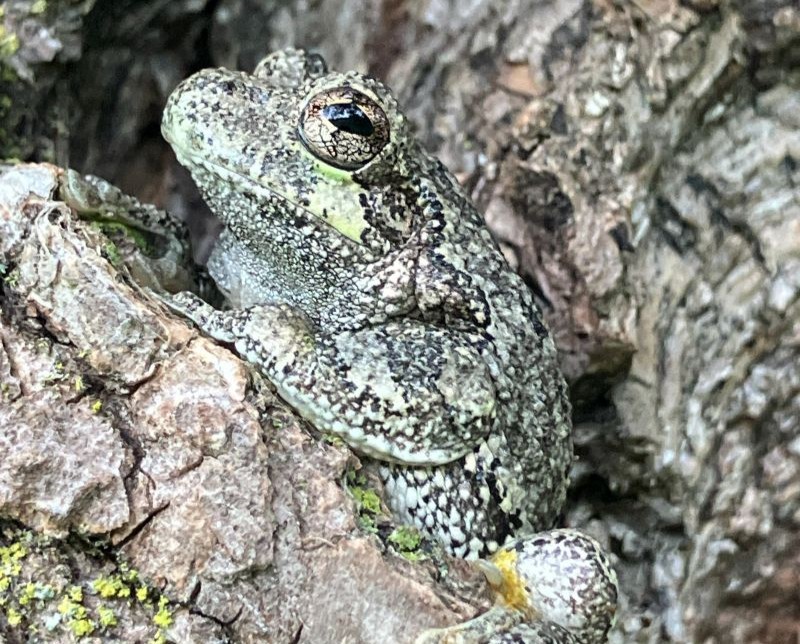
The photo accompanying this article shows a grey tree frog, one of six frog and toad species that use Lost Lake as a breeding site during the spring and summer.
While I believe it is a grey tree frog, I am not completely certain. It could potentially be a Cope’s grey tree frog, which is a distinct species but nearly impossible to differentiate from the grey tree frog by sight alone, even upon close examination.
You might be wondering, “How can you tell them apart if they look so much alike?” The answer lies in how they sound. Just like birds, male frogs and toads use vocalizations to attract female mating partners. Consequently, the grey tree frog can be distinguished from the similar-looking Cope’s grey tree frog by its unique call.
In light of our recent discussion about frog and toad calls, I want to share some information about the frog and toad survey conducted by volunteers of the Friends of Wisdom Prairie.
This initiative is part of a statewide citizen science project with the Wisconsin Department of Natural Resources, and helps us understand the impacts of our land stewardship work at the monastery. From mid-March to mid-August, an acoustic recording device was used to monitor frog and toad calls at Lost Lake to identify the frog and toad species using the lake as a breeding location.
The monitor was programmed to record 10-minute sessions about 30 minutes before sunrise and 30 minutes after sunset each day, resulting in 307 separate audio files. Each file was reviewed using software that enabled us to listen to each file and identify frog and toad species calling in them.
During the spring and summer of 2026, six species of frogs and toads were identified using Lost Lake as a breeding site. In order of the frequency of their calls they were the green frog, the grey tree frog, the Cope’s grey tree frog, western chorus frog, northern leopard frog and the American toad.
Gathered over several years, this data can help us better understand the environmental conditions around Lost Lake.
In addition to recording frog and toad calls, our monitor also captured bird calls. While listening to the recordings, we used a mobile application to identify the birds by their calls and noted these findings.
Although it is beyond the primary scope of this article, it is interesting to note the recorded calls of gobbling wild turkeys, the hoots of adult great horned owls, and the begging screeches of their juveniles. We also noted many waterfowl feeding at Lost Lake, as well as songbirds nesting in the surrounding trees and prairie.
Comments 2
THank you!!!
Very cool. Thanks Howard. Michael