

Submitted by David Kelly (he/him). All photos by David Kelly.
It’s finally spring.
The ice and snow have melted and Holy Wisdom and there’s a lot to see. From woodlands to wetlands, life is awakening from its icy slumber. It’s time to explore.
The early morning shadows stretch across the forest floor. Soft, moist ground gives way beneath your feet. Fallen twigs crackle as you walk. Each step stirs the musky aromas of last fall’s decomposing leaves. Shrubs show tiny buds, packets of energy, ready to burst. Oak, hickory and black cherry trees tower overhead. Leaves haven’t appeared, so you can still see blue sky through the lattice of intertwined branches. These trees are chock full of birds, dancing like sprites in the early sunlight. Woodpeckers drum rhythmically, while gangs of Dark-eyed Juncos roam the understory. You may spy a male Northern Cardinal. He glows crimson like a beacon as he sings from a nearby thicket. In the distance a Field Sparrow calls with its accelerating trill. You follow the call to the nearby prairie.
The prairie scene is monochrome as green sprouts hide beneath yellow grasses and brown thatch leftover from last year. These tiny shoots will soon pierce the thatch and vault skyward to paint shades of purple and violet against a verdant prairie backdrop.
You pause and stand still, an island in a prairie sea.
Listen to the music of the prairie play songs of American Goldfinches, Song Sparrows and if you’re lucky, an Eastern Bluebird. Songs envelope you as the trail turns westward.
You walk past the monastery building and descend the driveway on a gravel road. Then you round a curve past a small grove of pine trees where chickadees play. Then just ahead, tucked into a marshy wetland, you spy Lost Lake.
Lost Lake recalls the last Ice Age, a time when ice covered much of Wisconsin. It’s a kettle lake, formed over 10,000 years ago when a huge ice block cleaved off the glacier and sank deep into the frozen earth. Eventually the climate warmed and the ice melted, leaving an 8 acre bowl, called a kettle, which filled with water.
The Ho-Chunk people became the lake’s first stewards. They named it deyo-ha-waunee, Lost Lake. Lost Lake, or deyo-ha-waunee, sits on Ho-Chunk land and remains sacred today. Following forced removal of the Ho-Chunk in the 1800s by European settlers, the area became agricultural. During this this time the lake filled with sediment and shrank to just an acre. In 1953 the Sisters of Holy Wisdom Monastery acquired the land and later restored the lake to its current state.
As lakes go, Lost Lake is tiny. At 4.5 acres, it’s dwarfed by Lakes Mendota and Monona. It’s even smaller than Lake Wingra. But from a waterbird’s perspective, Lost Lake will do just fine.
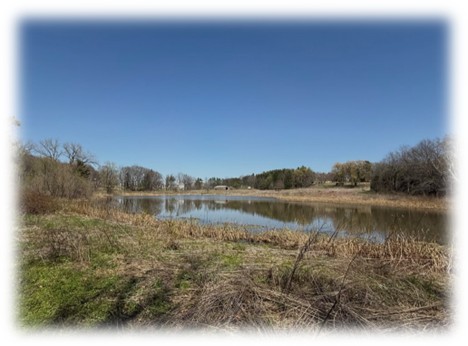
It glimmers gold and yellow in the morning sun. It’s bounded by emergent vegetation dressed in shades of brown, yellow and hints of green. Vegetation conceals all variety of fauna – more heard than seen. Frogs and toads trill from an invisible hideaway while tiny birds dart in and out of dense reeds, their calls ring out like tiny bells. A tiny muskrat forages quietly along the shore. And there’s plenty more.
As you approach the lake, you may encounter interesting waterbird species. Mallards and Canada Geese are common, but you may spot some waterbirds you don’t normally see. Buffleheads arrive early, sometimes in large numbers. These are small birds, but quite conspicuous. Males sport black and white feathers with a white patch on a large head. Females appear grayish brown with a smaller facial patch. Buffleheads are diving ducks, often vanishing from the lake’s surface to pursue underwater invertebrates.
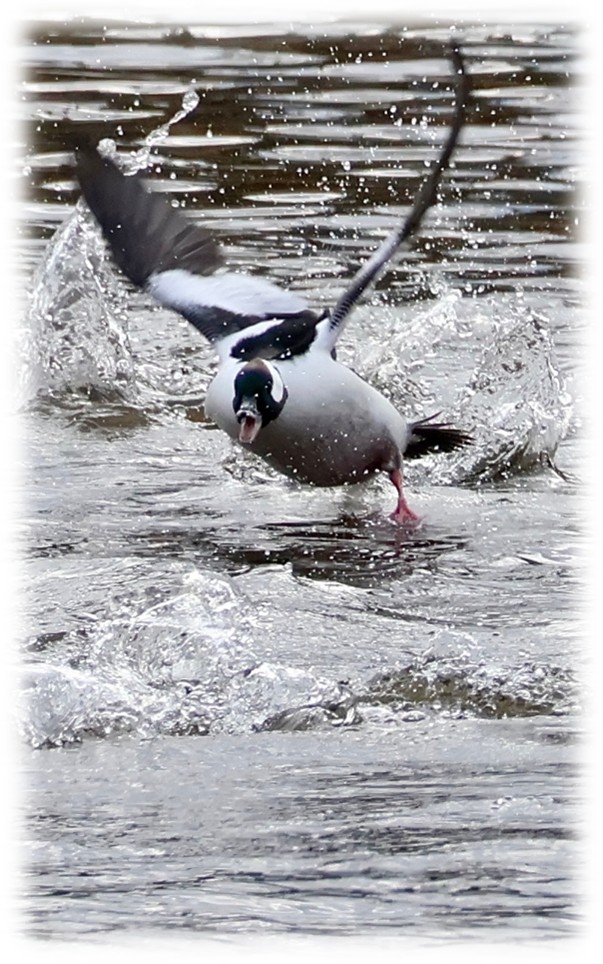
Active on the surface, Buffleheads chase one another, splashing silvery sprays of water everywhere. Spring is migration time and Buffleheads don’t linger. Soon, they fly off to breeding grounds in Canada and Alaska. They won’t be back until autumn.
Pied-billed Grebes are also present on Lost Lake. These intriguing brownish waterbirds are tiny, making them hard to see. Pied-billed Grebes are also divers and excellent underwater swimmers. While submerged they hunt crustaceans, fish and amphibians. Though resembling ducks in shape, Pied-billed Grebes are more closely related to flamingos. Last summer a pair of Pied-billed Grebes nested successfully at Lost Lake for the first time.
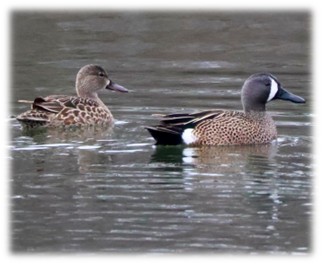
Blue-winged Teals sometimes forage near the edge of the lake. These small ducks are long-distance travelers, overwintering as far south as Venezuela and breeding from Wisconsin to as far north as Alaska. Males show distinctive white crescents in front of the eye. In flight they display blue patches on their underwings, giving the birds their name. Blue-winged Teals are seen in small groups, sometimes mixed with other duck species. The teals are dabbling ducks, meaning they forage with their heads submerged and their rear ends bobbing above the water line.
Green-winged Teals also appear on the lake. They have cinnamon colored heads while males have a shiny green crescent behind their eyes and a distinctive white line on their flanks. Females are brown and darker than the males. Both sexes flash distinctive green wing patches in flight, which can be beautiful if the lighting is right.
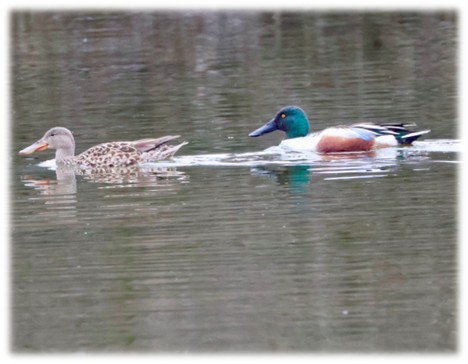
Northern Shovelers are also dabbling ducks. They’re distinguished by a large spoon shaped bill. The bill’s comblike edges enable the shovelers to filter tiny crustaceans from the water. When feeding, these ducks swim with their bills dipped in water, as they scoop up prey. Shovelers also engage in vortex feeding where groups form tight circles to create a vortex that stirs up food. Male Northern Shovelers have dark green heads, bright white breasts and a conspicuous rusty patch on their flanks. Female shovelers are mottled brown with a large orange bill. Like the Buffleheads, Northern Shovelers leave for their breeding grounds during spring.
Wood Ducks are seen on Lost Lake year round. They nest in nest boxes or in tree cavities. You may even encounter a couple high on a branch in the forest. In breeding plumage, ornate male Wood Ducks display colorful patterns.
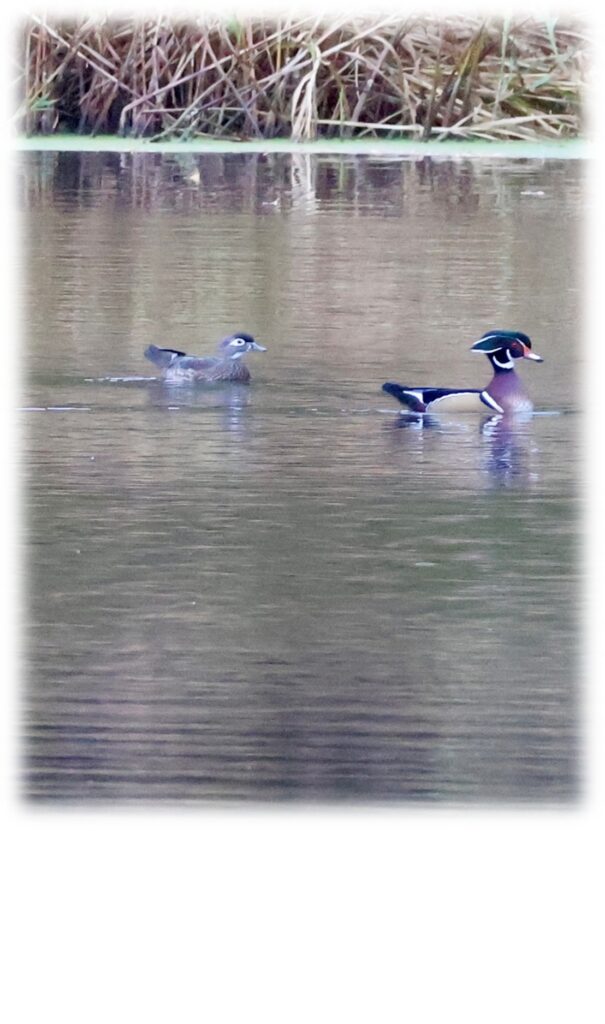
Look closely and see their large, red eyes. The female is grayish with a distinctive white eye ring. Wood Ducks are skittish and flush quickly when approached.
These are just a few of the waterbirds one might observe gliding like tiny ships across Lost Lake. In the past, over 30 species of water birds have been spotted on this tiny wetland!
On your next visit to Holy Wisdom, take a walk to Lost Lake, you’ll never know what you’ll find. Be sure to bring your binoculars!