

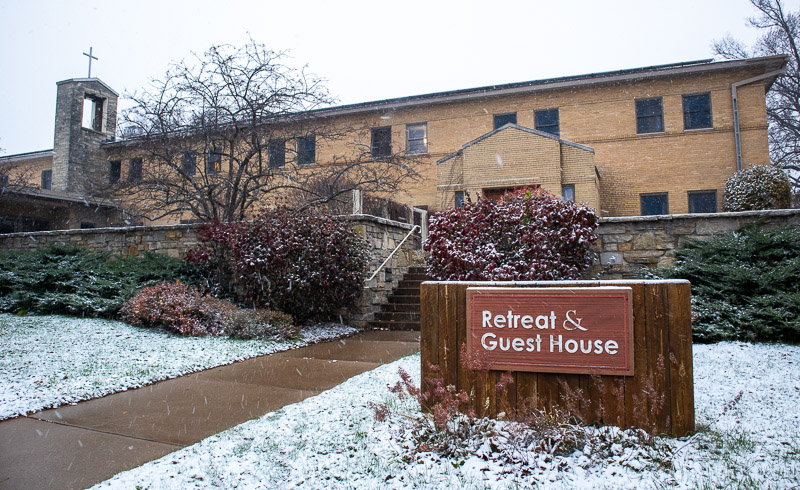
By Erin Trondson, Executive Director
I have been thinking a lot about the meaning of retreat. The Oxford dictionary offers us the definition: a quiet or secluded place in which one can rest and relax and a period of seclusion for the purposes of prayer and meditation. There is evidence of religious retreats that date back to the third century, and yet when I say I am going on retreat to my family or friends, they often tilt their head to the side and confusion clouds their expression. How can this gift be so unknown during a time when it may be exactly what we need?
I am still (and likely will always be) a novice in all things monastic (again, deep gratitude to this community and the sisters for their constant patience and sharing of their wisdom and knowledge), but I do know the benefits of retreat. I see it here daily when I witness individuals who come searching, who are threadbare and tired, who need their cup filled. I observed the Center for Clergy Renewal pastors, who have graced these halls this past week, move from exhaustion to joy during their time here. I myself have spent days here in solitude over the past 20+ years and feel the awe of a change in perspective that time by myself and in silence can bring.
What I find interesting is not the fact that the nourishment of retreat is good for us, but that this is so unknown as a practice, and in danger of extinction, during a time when we may need what it offers most. I would argue that centuries ago, actually even only decades ago, there were ways to ‘retreat’ throughout the day that helped us balance, be silent, and be still. One could use the moment of sweeping the floor to become present again. The stroll to the market provided a time to drop into oneself. Falling asleep and waking up gave us moments of silence as we left the day, and before we greeted it, as we moved through the veil from sleep to wake, and from wake to sleep.
I would guess that now, many engage instead with their phones during these daily opportunities for retreat. As our all too brief moments to be present continue to be absorbed and disappear, I wonder if the concept of ‘intentional retreats’ might be revisited. My guess is seclusion, prayer, silence, balance (and many more of the Benedictine values) are ripe and medicinal for several of the ailments we are experiencing at present. I think of the epidemic of loneliness, the struggles with insomnia, the constant racing minds, and the brain fog so many experience today. I think of the fear, the exhaustion, and the constant state of vigilance so many live in – and I wonder if retreat might help.
We know that offering retreats is one of the many ways that Holy Wisdom expresses deep hospitality, and I am curious how we might expand this. I wonder if a retreat could be a medicine or salve for those working so hard on the front lines – I wonder of its healing powers. We see healing occur with the pastors, how when Holy Wisdom nourishes and cares for this group, they are able to return to their vocations renewed and ready to serve the tender and vulnerable again. By filling the cups of those folks who tirelessly work for justice, for peace, for the wellbeing of our climate, for humans and non-humans – might we also be supporting that greater work?
Radical hospitality is a phrase that comes to mind. Nancy Enderle sent me a recent episode of To the Best of Our Knowledge titled Retreat from the Day-to-Day Life which has continued my contemplation of the retreat during these times. Of particular note was the beautiful interview with Pico Iyer who discusses the important role of retreats in the story of his life and in support of his writing. Please enjoy the podcast and consider how Holy Wisdom might continue to contemplate our practice of radical hospitality and offering retreats as part of our work in healing a hurting and wounded world.
Comments 1
Beautiful article, Erin! You have such an open heart! May it bring you much grace and many blessings!