


By Isaac Ruby (they/them, he/him), Land Management Summer Intern
WHAT AM I DOING?
As one of my many projects as Land Management Intern this summer, I’m doing a phenological survey of two sites here at Holy Wisdom. Phenology is essentially the study of natural environments over time. Imagine something akin to Henry David Thoreau’s notes at Walden Pond, with an added layer of scientific understanding or site consistency. Phenology logs have been a required component for many courses I’ve taken at Lawrence University, where I’m tasked to return to one outdoor spot over the course of a semester and observe the goings-on: what insects do I see, or birds? How tall has that plant grown? What is flowering, dying, rotting, sprouting? It is the best way I know to get to know anywhere’s secrets; when I got to Holy Wisdom, I knew I wanted to do a phenology log so I could know this land more closely.
Less selfishly: phenology logs can be incredibly useful as longitudinal looks into an environment’s cycles and behaviors. Knowing what species are present, which are about to drop seed, which invasives are poking in – all can be critical data to consider when managing land, and may be useful in the future to look back on and get a sense of the changing landscape. This land is forever a work in progress. The more documentation of its changes, the better.
I asked Emma Kloes (my supervisor) to pick out two sites to monitor. Twice a week at each site, I sit with a bird field guide and Merlin Bird ID, a birdcall identification app, and count as many birds as I can in 10 minutes. These data, which are called a bird point count, can tell lots about the ecosystem’s health and functionality. I spend the next twenty minutes noting the plants around me, taking pictures, and tromping into the brush for a closer look.
This will be one of three entries synthesizing my notes as I encounter the sites over the summer. Below, I introduce the sites and include some of my notes from my sessions so far.
Amelia: This area doesn’t have a formal name, as far as I know. (I named it Amelia after a shape note song I love.) Just northwest of the overlook and orchard, this little pocket of land used to be dominated by burdock and honeysuckle, two co-conspirator invasives that can choke out the underbrush if not dealt with. Now, they’ve been whacked back by the Land Management Team and volunteers, and more than a dozen shrubs have been planted, still in their baby blankets of chicken wire fencing to keep them safe from browsing deer. The land here is young in this stage of its development. Amelia is dense and teeming and tucked away; the birdsong is unending.
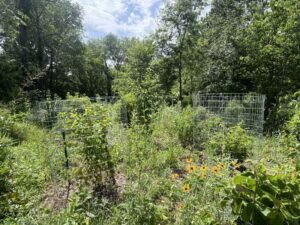
(Note: Shape note music is a style of social singing popularized in the 18th century to make learning to sing from sheet music as easy as possible. It’s a tradition very near to my heart. Shape note songs are often named arbitrarily; the song Amelia has nothing to do with anyone named Amelia. I named the shrub patch Amelia to continue that tradition of naming something beautiful with a placeholder. Shape note songs cannot be understood by reading their names; one needs to hear and participate in the music. Amelia the shrub patch is the same.)
June 22:
- Wow! This is a good place for bugs—assailed by flies immediately, juicy wood tick on my pant leg, dragonflies & little glittery green fliers & gnatlike things in the air. For the bird [point count], I’m perched on a dead stump in the shadow of an ambitious Northern Arrowwood [shrub]. Facing a dead tree with a lovely neckbrace of some vine—birds that perch on it are immediately obvious.
- I’m immediately endeared to the dorky white sage, which is poking in various directions, often stuck in the chicken wire meant to support the new shrubs. Fine, feathery yarrow pokes through the ground. What a buzzy, hot, alive place.
- On my walk in, the compass plants seemed too proud to talk to me. The flower stalks [which are a few feet tall, not too many open blooms yet] were facing away from me, but the leaves (which tend to position the flats of their leaves facing east/west to conserve water) were greeting me. So glad you’re here, they said. The flowers are a little shy today.
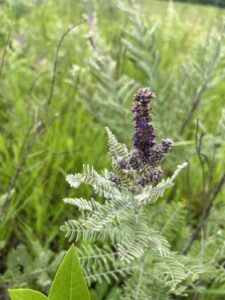
- [I see] leadplant to the [southern side of the trail] with soft gray/pink heads [emerging from the plant]. Hard to tell—has it already bloomed? Will bloom [soon]?
- Marbleseed is FULL of seeds, many starting to deepen in color as they ripen. They appear to ripen from the bottom up. When I tried to pull a seed loose, it didn’t budge. Should be a while before we need to harvest.
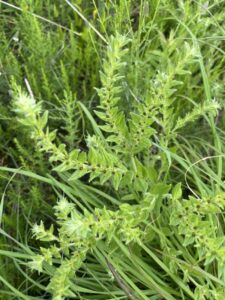
- Happy bees gorging themselves on every [oxeye] sunflower I can spot—not sure what type. Little, but not as small as sweat bees, I don’t think?
June 25:
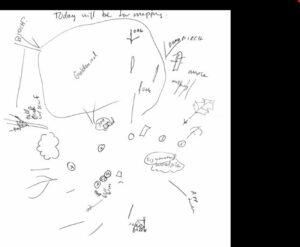
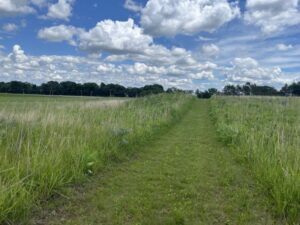
- I spent the whole 20 minutes drawing this map: Rockytop: A high point on the southeasternmost prairie, tucked into the curve of Highway M. Back when this land was farmland, the farmers gathered wayward stones from around the landscape and left them in this spot, hence, Rockytop. Surrounded by grasslands, this small point is quite biodiverse, and there’s an obvious edge where the scrubby, lively raspberries and white heath asters stop and the woody skeletons of last year’s grasses begin. This prairie has seen lots of maintenance over the years; invasives are absent for the most part. The highway noise is omnipresent here, and I feel exposed under such a heavy sky. I feel as though I can see everything. Looking down at the northern prairie, big swathes of the land are blushing pink from echinacea.
- The leadplant is starting to [bloom]—tiny purple blooms with vivid orange [stamens].
- The red-winged blackbirds here have more calls than the ones at home. I wonder if they have regional accents, or maybe the birds here are just happier in their natural habitat. Most of the time, they’re down in the prairie, but they’ll perch on the tall grasses or young oaks and chirp at me when I get anywhere near their nests. You can see exactly where each pair’s territory begins—they’re each about 15-30 feet apart. They’re not too aggressive, which makes me think no babies yet. Must be soon.
If you have a chance to make it to Rockytop or Amelia this summer, I hope you will. See if you notice the species I do, or others. Already, I feel closer to these pieces of land as I return to them to write down their little mysteries.
Comments 1
Isaac, I just found this gem you wrote. I am so glad that you were drawn to these spots. What beautiful observations! Will you be sharing more of them?